Sixteenth Week
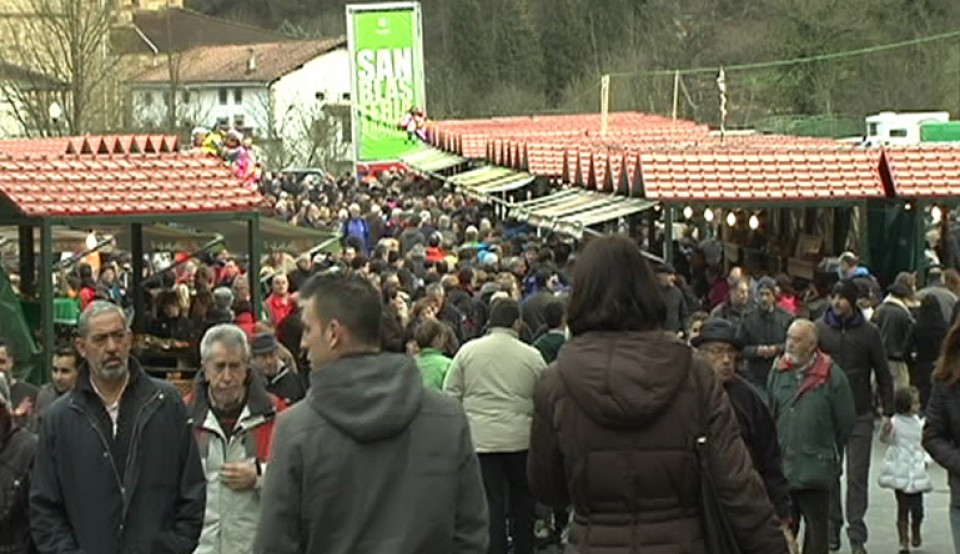
On Monday we didn't have class because it was the patron Saint's day of Abadiño, San Blas. In these Patron Saint's celebrations, cattle are brought to the town square and in the same square traditional foods of the Basque Country are prepared and sold. It is a good day to go sightseeing and buy homemade food while you enjoy seeing hundreds of animals just a few centimeters away.
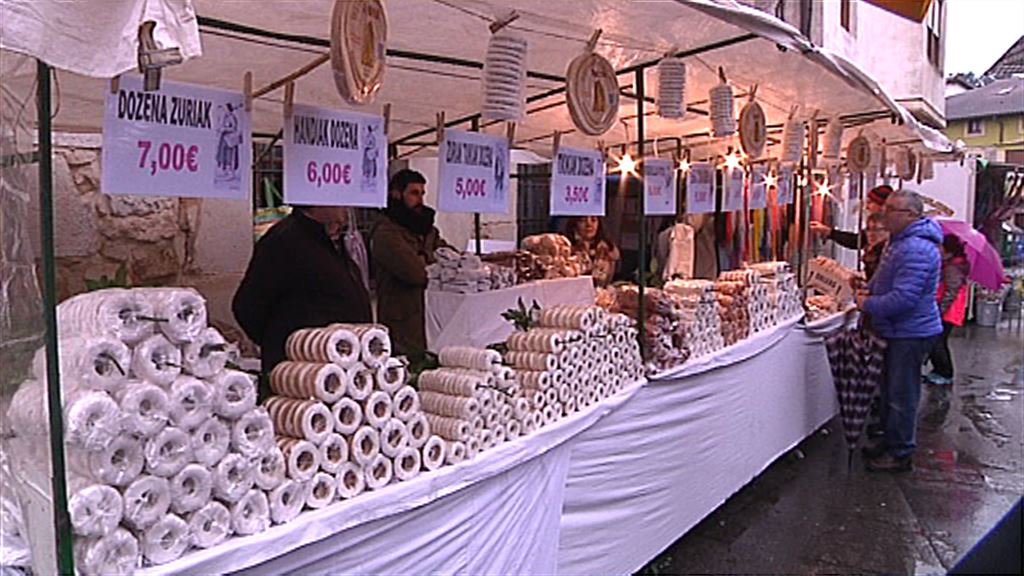
On top we can see people from The Basque Country and foreigners too are going for a walk and join themselves to the local celebrations. On the left there is a street market where people can look at diverse products which are offered by local entreprenuers. People can find delicious dishes and products from the zone and they have the chance to learn a little bit of the culture of native people from there.
On Tueday, at first hours there was a planned class by our teacher of Technical drawing. That class was about Surfaces , how to create surfaces on Catia V5 precisely. At the beginning of the subjet our teacher taught us some basic info about how we should use all commands inside the platform and their functions. After getting into the platform of surfaces, we proceeded to practice with exercises in order to get used to it and get confidence.
Next we are gointo to show some samples of exercises linked to surfaces through Catia V5:
On Tueday, at first hours there was a planned class by our teacher of Technical drawing. That class was about Surfaces , how to create surfaces on Catia V5 precisely. At the beginning of the subjet our teacher taught us some basic info about how we should use all commands inside the platform and their functions. After getting into the platform of surfaces, we proceeded to practice with exercises in order to get used to it and get confidence.
Next we are gointo to show some samples of exercises linked to surfaces through Catia V5:

We can see in the next image the main stages that we need to follow in order to work properly in the module of Generative Shape Design (Surfaces), so we will obtain magnificent outcomes. In this exercise we will design and draw a mouse for a computer.
At first stage, we need to create a sketch from where we will start creating the close surface and then likely this can turn into a solid.
At second stage, here we will create a cavity so that mouse buttons can be positioned in there. In there, commands such as Trim and Split can be used to build that cavity.
At third stage, Independently we create the mouse buttons so that we can later overlap them over the main body of the our mouse. Again we need to use commands such as Trim or Split.
At fourth stage, Once we get the body of the mouse buttons, we proceed to create a new cavity on the lower part of it, so that both cavities of the body of the main body and the mouse buttons can overlap perfectly. There are many ways of doing a cavity for example by using the command Shell
At fifth stage, the front face will be divided into three parts, each one of them will be a button for each finger. Again we will use the command Trimp in order to create thin spacings:
At second stage, here we will create a cavity so that mouse buttons can be positioned in there. In there, commands such as Trim and Split can be used to build that cavity.
At third stage, Independently we create the mouse buttons so that we can later overlap them over the main body of the our mouse. Again we need to use commands such as Trim or Split.
At fourth stage, Once we get the body of the mouse buttons, we proceed to create a new cavity on the lower part of it, so that both cavities of the body of the main body and the mouse buttons can overlap perfectly. There are many ways of doing a cavity for example by using the command Shell
At fifth stage, the front face will be divided into three parts, each one of them will be a button for each finger. Again we will use the command Trimp in order to create thin spacings:

On the other side, the third challenge of this year has been shown by our professors. For this new project we have to apply reverse engineering for a plastic injection mold. If we have a look inside the document, immediately we can notice the most fundamental objectives to undertake. Next those points are going to be mentioned:
I.To take measurements of different pieces of a machinery (Plastic injection mold).
II.To evaluate how it works and find out what kind of shape or solid can be created from it.
III.To start drawing blueprints from those metal pieces and specify geometrical and dimensional tolerances. The major goal of this target is to produce good blueprints.
IV.To update our English logbook or blog where each member of us has to write our progress down weekly.
V.To organize and evaluate our weaknesses and strengths personally and as a group and business. All the date must be registed in a matrix which is called SWOT analisys, which means:
V.I Strengths: characteristics of the business or project that give it an advantage over others.
V.II Weaknesses: characteristics of the business that place the business or project at a disadvantage relative to others.
V.III Opportunities: elements in the environment that the business or project could exploit to its advantage.
V.IV Threats: elements in the environment that could cause trouble for the business or project.
I.To take measurements of different pieces of a machinery (Plastic injection mold).
II.To evaluate how it works and find out what kind of shape or solid can be created from it.
III.To start drawing blueprints from those metal pieces and specify geometrical and dimensional tolerances. The major goal of this target is to produce good blueprints.
IV.To update our English logbook or blog where each member of us has to write our progress down weekly.
V.To organize and evaluate our weaknesses and strengths personally and as a group and business. All the date must be registed in a matrix which is called SWOT analisys, which means:
V.I Strengths: characteristics of the business or project that give it an advantage over others.
V.II Weaknesses: characteristics of the business that place the business or project at a disadvantage relative to others.
V.III Opportunities: elements in the environment that the business or project could exploit to its advantage.
V.IV Threats: elements in the environment that could cause trouble for the business or project.


On Wednesday, at the beginning Julen gave us some pieces of papers which contained some exercises of Surfaces; we all together resolved those exercises and at the same time he explained which commands we have to use in order to achieve building the piece. Afterwards my team and I had to complete all the remaining chapters inside our technical report for the second challenge. At 13:00 p.m we finally ended our report up, then Erik and I went to print it in color. Next there are some samples of it:


 On Thursday, practically most of the day we had a class of sheet metal forming; specifically Deep drawing and it was explained by teacher Gaizka. We consider this theme as one of the most highlightest courses in our studies because there are lots of businesses relating to it. He is planning to take us an exam the next Friday about this theme so that we can end the course up with basic knowledge about it at least.
Finally on Friday all students from our class had to take a final evaluation relating to the second challenge (Iron casting). This exam has a huge importance in percentage for our final scores. Afterwards, we carried on measuring metal pieces of the plastic injection mold.


No hay comentarios:
Publicar un comentario